Airport Security
The restrictions applicable to the transportation of certain items and substances are intended to ensure civil aviation operational safety, protecting passengers, crew members, and ground personnel. These measures are based on the regulations of the International Civil Aviation Organization (ICAO), the National Civil Aviation Security Program approved by the Directorate General of Civil Aviation, as well as the security procedures of José Joaquín de Olmedo International Airport.
We recommend reviewing this guide before packing your luggage and attending the security screening process.
Restricted items in checked baggages
For security reasons, the following items are prohibited in an aircraft's cargo area:
- Ammunition
- Detonators
- Explosive caps
- Fuses
- Mines
- Grenades
- Military explosive articles
- Pyrotechnic materials
- Fireworks
- Cartridges
- Dynamite
- Gunpowder and plastic explosives
- Chemical and toxic substances
Important: The list of prohibited items is provided for reference purposes only and does not limit the enforcement of other restrictions established by civil aviation security regulations, competent authorities, or airlines.
Restricted items in hand baggages
Firearms and projectile-launching devices, or objects that may be mistaken for them:
- All types of firearms
- Pistols
- Revolvers
- Rifles
- Shotguns
- Replicas and imitations of firearms that may be mistaken for real weapons (including toy guns)
- Firearm parts
- Compressed air guns
- Bows
- Crossbows
Devices used to stun or immobilize:
- Electric defense weapons
- Electric batons
- Stunning and animal-killing devices
- Disabling and incapacitating chemical substances
- Macis gases and aerosols
- Pepper or dried chili spray
- Tear gas
- Acid aerosols and animal repellents
Sharp objects with cutting edges:
- Cutting objects
- Shredders
- Axes
- Hatchets
- Blades
- Ice axes and hooks
- Multi-purpose knives
- Utility knives
- Knives with blades longer than 2.3 inches
- Scissors with sharp tips and blades longer than 2.3 inches measured from the pivot
- Martial arts items with sharp edges
- Swords
- Short swords
- Sabers
- Stock canes
- Scalpels
- Stilettos
Work tools that may cause serious injuries:
- Iron crowbars
- Drills and augers
- Portable electric drills
- Tools with blades or shafts longer than 2.3 inches
- Screwdrivers
- Chisels
- Cold chisels
- Ice picks
- Saws
- Blowtorches
- Wrenches
- Pneumatic guns
- Machetes
- Gardening scissors
- Tool cases
- Medical and dental instrument cases
- Hammers and mallets
Blunt instruments that may be used for striking:
- Baseball bats
- Softball bats
- Batons
- Clubs and truncheons
- Martial arts equipment
Explosives, flammable substances:
- Ammunition
- Detonators
- Explosive caps
- Fuses
- Replicas or imitations of explosive devices
- Mines
- Grenades
- Military explosive articles
- Pyrotechnic materials
- Fireworks
- Cartridges
- Dynamite
- Gunpowder
- Plastic explosives
- Lighters
Important: The list of prohibited items is provided for reference purposes only and does not limit the enforcement of other restrictions established by civil aviation security regulations, competent authorities, or airlines.
Power Banks with lithium-ion batteries
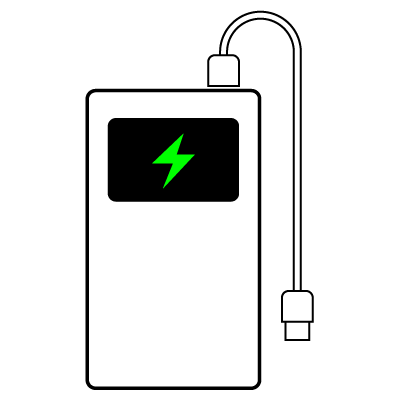
Regarding portable energy storage devices designed to charge electronic equipment in the absence of a power socket, which contain lithium-ion batteries (power banks and portable electronic devices), and have a nominal capacity of up to 100 Wh:
- Must go in your hand baggage
- Must not be recharged while on board the plane
- Must not be used to charge other portable electronic devices while on board the plane
- Only two power banks per person allowed, individually protected while not in use to avoid short-circuits (stored in their original package or covering the terminals, either with tape or placing the device in a protective bag or pouch)
If your battery's nominal capacity is between 101 Wh and 160 Wh, you must declare it with your airline at the time of check-in. If your battery exceeds 160 Wh, it will not be allowed in the airplane.
Alcoholic beverages
Regarding alcoholic beverages, the rules are as follows:
! For domestic outbound flights passengers can travel with up to 5 liters (1.3 gallons) per person, either in checked or hand baggage.
! For international outbound flights passengers cannot travel with alcoholic beverages in hand baggage. For alcoholic beverages in checked baggage, please consult your destination's Customs restrictions.
! For international arriving flights Customs allow up to 3 liters (0.79 gallons) per person*, either in checked or hand baggage.
Note: Beverages must be in their original container and factory sealed, with their proper sanitary registry.
* Starting on May 4, 2026
Important: Before your flight, we recommend checking the official Customs website before your flight, in case there are any changes to these restrictions: https://www.aduana.gob.ec/viajeros-por-via-aerea/ (in Spanish).
Liquids, aerosols and gels (LAGs)
There are current regulations regarding the permitted quantity of liquids, aerosols, and gels (LAGs) in carry-on baggage for international flights. These measures are intended to ensure passenger safety and the security of air operations.
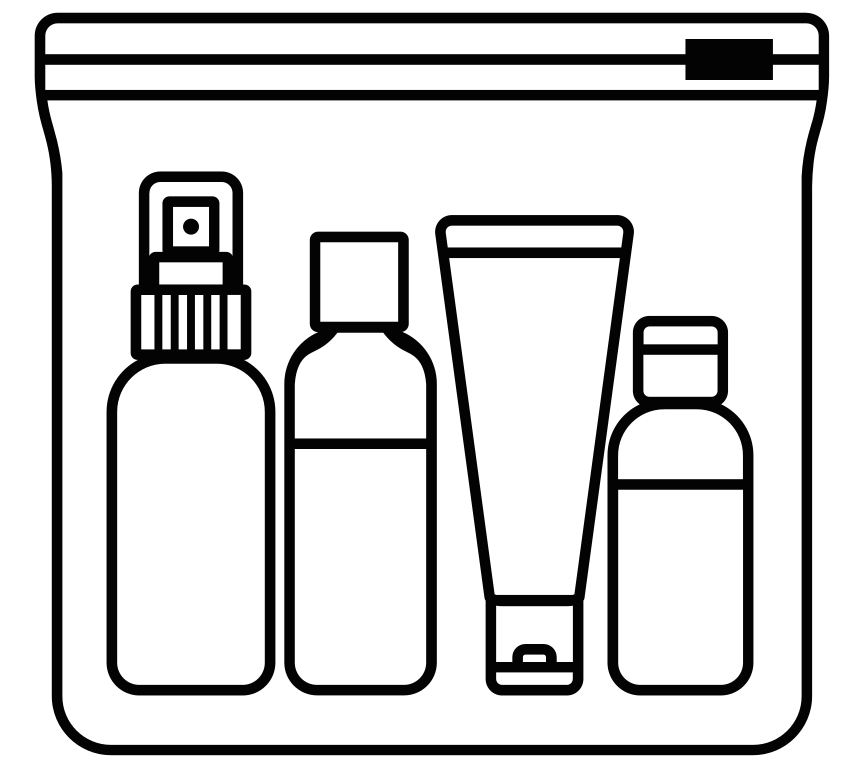
Only liquids, gels, and aerosols for personal hygiene or cosmetic use are allowed in carry-on baggage, provided that:
- They are in their original containers.
- Each container does not exceed 3.4 oz (100 ml).
- All containers are placed inside a single transparent, resealable plastic bag with a maximum capacity of 1 quart / 1 liter (35 oz) per passenger.
- The contents fit comfortably and the bag can be completely sealed.
No LAGs in containers larger than 3.4 oz (100 ml) are permitted, even if partially filled. Items that exceed the allowed quantities, lack proper identification, or do not comply with these conditions cannot be transferred to another container and must be confiscated and disposed of in accordance with applicable security protocols.
Passengers must provide their own resealable bag and have it ready before going through the security screening process.
This bag must be presented separately at the checkpoint and will be screened through the X-ray machine, so it is recommended to keep it easily accessible.
List of LAGs included in this regulation:
The following items are considered liquids, aerosols, and gels, although this list is not exhaustive:
- Beverages: water, juices, soft drinks, and other drinks.
- Non-solid or high-liquid-content food: soups, broths, syrups, jams, stews, sauces, pastes, purées, foods in sauce, preserved and canned foods, even if partially drained.
- Liquid-solid mixtures: products that combine solid and liquid elements.
- Toiletries: shampoo, conditioner, toothpaste, mouthwash, perfume, shaving foam and other foams, aerosols, deodorant, eye care products.
- Cosmetic products: perfume, hairspray or hair gel, lip gloss, mascara, nail polish, makeup remover, liquid foundation.
- Creams and similar products: creams, ointments, lotions, oils.
- Any other item that, at room temperature, has a liquid, gel-like, or semi-solid consistency.
Guidelines for transporting medication on international flights
Passengers are allowed to carry medicines in their hand luggage for use during the trip, provided they are presented separately at security checkpoints and contained in a transparent plastic bag.
Substances that are not medicines but are used for other medical purposes may also be transported. Examples include dry ice to maintain the temperature of an organ for transplant, blood and blood products, and even beverages if their use is justified for medical reasons, such as a case where an autistic passenger requires a specific brand of drink.
Keep in mind:
- In both cases, passengers must carry documentation justifying their particular condition, as proof of authenticity may be requested at security checkpoints (e.g., a prescription, medical treatment plan, etc.).
- Security personnel must verify that the name on the medication label matches the name on the prescription.
- For over-the-counter medications, a reasonable quantity should be considered, including what is necessary for the duration of the trip, taking into account possible delays and diversions.
Guidelines for transporting infant food

Baby food is allowed in carry-on baggage, provided that:
- The child(ren) are traveling with the passenger.
- The products are intended for consumption during the journey.
- They are presented separately during security screening.
- They are not required to be placed inside the LAGs resealable bag.
Acceptance of these items will be subject to validation at the security checkpoint, considering the type of food, the quantity carried, and applicable safety conditions.
Guidelines for transporting food for special needs or dietary restrictions
- Food items must be presented separately during security screening.
- Security personnel may conduct an evaluation at the checkpoint to determine whether the items are permitted.
- Presenting medical documentation does not automatically guarantee approval, as the final decision is based on applicable aviation security criteria.
Please note that not all liquid or semi-liquid food items may be accepted, even if intended for special dietary needs.
The acceptance of these products will be subject to validation at the security checkpoint, considering the type of food, the quantity carried, and applicable safety conditions.
Inspection and Handling of Restricted Items
During the security screening process, carry-on baggage may be inspected using X-ray equipment and, when necessary, supplemented with a manual inspection, which is carried out in the presence of the passenger responsible for the baggage.
If an item that does not comply with permitted conditions is identified, it may be confiscated and removed from the carry-on baggage.
The inspection is a mandatory requirement, and compliance is essential to access the boarding area and proceed with aircraft boarding.
Travel to the United States: TSA Regulations
The U.S. Department of Homeland Security requires the implementation of enhanced security measures, both visible and invisible, at approximately 280 foreign airports with direct commercial flights to the United States, in more than 100 countries, including Ecuador.
Passengers traveling to the United States are reminded that, in addition to security checks at Guayaquil Airport, airline security personnel may conduct a random, more thorough screening process. Therefore, we recommend preparing for a possible additional inspection of your belongings and personal electronic devices. For this reason, we advise consulting the list of prohibited items published by the U.S. Transportation Security Administration (TSA).
Recommendations for All Passengers
To avoid delays during the security screening process, please review the available information in advance. Check this section prior to your trip and, if necessary, also verify the specific restrictions of your airline or destination country.